
- 09763635252 Call Us Now
- appointment@kaizengastrocare.com Email Us
- Home
- About Us
- GI Services
- GI Surgeries
- GI Cancer
- GI Motility
- Diet for Gut
- Patient Care
- CSR
- Contact Us
Diverticular Disease Treatment in Pune
Diverticular Disease Treatment in Pune
Stomach pain that keeps coming back? Bloating, irregular motions, or discomfort in your lower belly? These symptoms may sometimes be linked to diverticular disease and should not be ignored, especially when they are persistent or getting worse.
At Kaizen Gastro Care, we provide personalised Diverticular Disease Treatment in Pune, from proper diagnosis and medical management to surgical care when required. The treatment team includes Dr. Samrat Jankar, Director and Head of GI Surgery, who has 17+ years of experience in Surgical Gastroenterology and Colorectal Surgeon in Pune.
He has completed his DNB in Surgical Gastroenterology and received specialised surgical training at GEM Hospital, Coimbatore. His experience in complex GI and colorectal surgery supports a careful approach when diverticular disease requires surgical evaluation.
The team is also led by Dr. Vikrant Kale, Senior Gastroenterologist, Hepatologist and Interventional Endoscopist, with 18+ years of experience in gastroenterology. Dr. Kale has international medical training, including MRCPI and CSCST-Gastro from the Royal College of Physicians of Ireland, along with fellowships in Upper & Lower GI Endoscopy and Inflammatory Bowel Disease from Oxford University, UK. He has also worked in gastroenterology roles across hospitals in Ireland and the UK, bringing international clinical exposure to digestive disease care in Pune.
With the combined expertise of Dr. Samrat Jankar and Dr. Vikrant Kale, Kaizen Gastro Care provides coordinated gastroenterology and GI surgical care for patients with diverticulosis, diverticulitis, recurrent symptoms and complicated disease. Our focus is on understanding the cause of your symptoms, identifying complications early and choosing a treatment plan suited to your individual condition.
What is Diverticulitis and Diverticulosis?
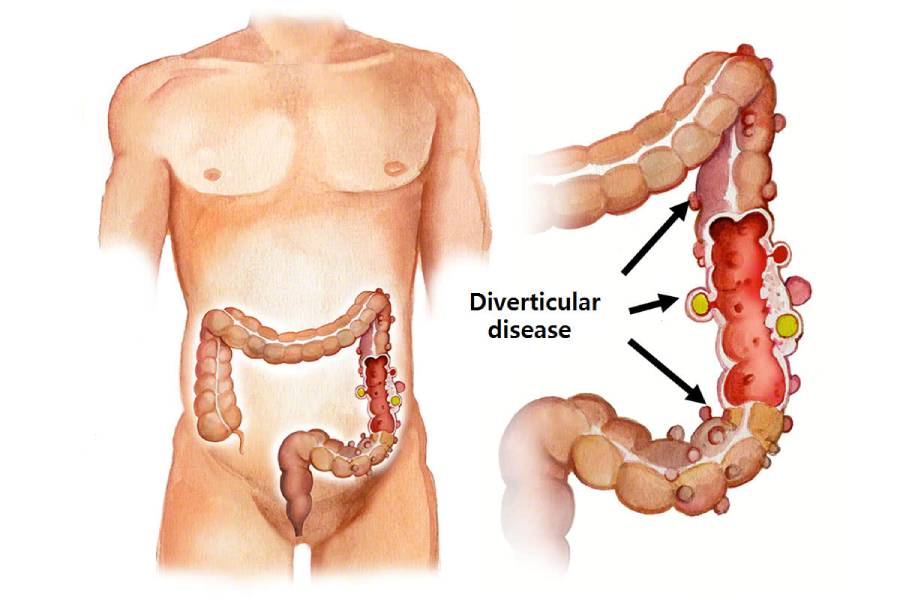
Our large intestine (colon) has a smooth inner wall. Over time, small weak spots can develop in this wall. When pressure builds up inside the colon, tiny pouches push out through these weak spots. Doctors call these pouches “diverticula”.
Having these pouches, without any pain or problem, is called diverticulosis. It is a very common condition and mostly harmless on its own. But sometimes, these pouches get blocked with stool or waste. Bacteria grow inside them, and the pouches become inflamed or infected. This painful condition is called diverticulitis.
Together, both conditions are known as diverticular disease. Understanding the difference matters, because the treatment for each is quite different.
What is the difference between diverticulosis and diverticulitis?
Diverticulosis: Diverticulosis is simply the presence of these small bulges or sacs (diverticula) in your colon. They usually don’t induce any signs or need to be treated. Yet, diverticulosis can lead to diverticulitis.
Diverticulitis: Diverticulitis is inflammation and infection in one or more diverticula. You may sense pain, nausea, fever, and other signs. This is a much more serious and potentially dangerous situation.
How common is diverticulosis?
Diverticulosis becomes more common as we grow older. It is rare before the age of 40, but quite common after 50. In fact, many people above 60 years of age have some diverticula in their colon, often without knowing it. Only a small number of these people go on to develop diverticulitis in their lifetime. Still, it is important to get checked, especially if you belong to a high-risk group.
Who is most likely to get a diverticular disease?
Certain factors raise your risk of diverticular disease. These include:
- Age above 50 years
- A diet low in fibre and high in processed food
- Being overweight or obese
- Smoking regularly
- A sedentary lifestyle with little physical activity
- Long-term use of certain painkillers (NSAIDs)
- A family history of diverticular disease or colon problems
If you fall into one or more of these groups, it is wise to get a gut check-up, even if you have no symptoms right now.
What causes diverticulosis and diverticulitis?
It is not very clear what causes diverticula, but the medical science theory is that not eating sufficient fiber is the most important reason for diverticular formation. Not eating adequate fiber yields a buildup of waste (constipation) in your colon. Constipation puts extra pressure on the walls of the colon. This raised pressure causes the small pouches of the diverticula to develop in weak areas in your colon.
Diverticulitis happens when one or more of these diverticula become inflamed or infected. The inflammation and infection can be caused by fecal matter or bacteria becoming trapped in the diverticula.
What are the symptoms of diverticulitis?
The symptoms of diverticulitis can vary in severity and may include:
- Nausea and vomiting
- Constipation
- Fever and chills
- Bloating and gas
- Rectal bleeding
- Abdominal pain
- Cramps in the lower abdomen
- Loss of appetite
What are the symptoms of diverticulosis?
Usually, diverticulosis does not cause any troublesome symptoms. However, in some cases, diverticulosis may cause symptoms such as:
- Bloating and gas
- Constipation
- Tenderness over the affected area
- Abdominal pain
How is diverticulosis and diverticulitis diagnosed at Kaizen Gastro Care Pune?
Diverticulitis is typically diagnosed via a combination of physical examination, medical history, and imaging tests. If you have signs of diverticulitis, it’s important to be seen by a diverticular disease specialist to get the correct diagnosis.
- Physical examination: During a physical exam, Dr. Samrat Jankar may check your abdomen for tenderness or swelling, and may also perform a rectal exam to check for any symptoms of bleeding or infection.
- Medical history: Dr. Samrat Jankar will ask you about your medical history including your present signs, the types of foods you normally eat, how usually you have bowel movements, and other queries about your bowel movements, and will check any medicines you are now taking.
- Blood test: Your blood is checked for symptoms of infection, such as high WBC counts
- Stool sample: Your stool sample is studied for the presence of abnormal bacteria or parasites to rule out the infective reason
- CT scan: A CT Scan abdomen and pelvis can show infected or inflamed diverticula and even show the severity of diverticulitis.
- Colonoscopy: In this exam, the full length of the colon can be examined A light, flexible tube with a camera, called a colonoscope, is inserted via your rectum and into your colon. During a colonoscopy, your colon is checked for abnormal changes, ulcers, bleeding, or other issues that could cause differences in bowel habits or abdominal pain. It is very important in long-standing issues to rule out cancer.
- Sigmoidoscopy: In this exam, a narrow, flexible tube with a light on the end is inserted into the rectum & moved into the sigmoid colon. This tube is connected to a video camera. The camera allows visual inspection of your sigmoid colon and rectum.
How is diverticulitis treated?
If you are suffering from diverticulitis, consult Dr. Samrat Jankar. He provides the best Diverticular Disease Treatment in Pune, he will specify an oral antibiotic and other symptomatic remedies.
If your diverticulitis is mild, treatment may involve rest, dietary changes, and antibiotics, while more severe cases may require hospitalization and surgery.
Utilizing the state-of-the-art Da Vinci Robotic Surgical System, Dr. Jankar performs precise and controlled robotic-assisted surgeries. This technique enhances visualization and dexterity, making it ideal for complex cases of diverticulitis. Benefits of robotic surgery include:
- Reduced Recovery Time: Patients often experience faster recovery and shorter hospital stays.
- Minimized Scarring: Smaller incisions lead to less visible scarring post-surgery.
- Enhanced Precision: The robotic system allows for greater precision in delicate procedures, reducing the risk of complications.
If your diverticulitis is severe, you have rectal bleeding or are having a repeat episode of diverticulitis, you may be admitted to the hospital to acquire intravenous (IV) antibiotics, and IV fluids or possibly be assessed for surgery by Dr. Samrat Jankar if associated with difficulties.
When is surgery for diverticulitis considered?
Surgery for diverticulitis is typically considered in cases of severe or recurrent diverticulitis, or if complications such as perforation, abscess, fistula, or bowel obstruction occur. Surgery may also be considered if conventional treatments such as antibiotics and dietary changes are not effective in controlling signs or if you have other underlying health conditions that raise your risk of complications.
There are two primary types of surgery for diverticulitis:
- Bowel resection: This surgery concerns removing the affected part of the colon and reconnecting the healthy parts of the colon. This method is typically performed using minimally invasive techniques such as robotic or laparoscopy surgery.
- Colostomy: In some cases, a temporary or permanent colostomy may be essential if the affected region of the colon cannot be removed. A colostomy involves creating an opening in the abdominal wall through which feces can pass into a pouch that is attached to the outside of the body.
How can diverticulosis be prevented?
Although diverticulosis may not always be preventable, there are some lifestyle modifications you can make to assist decrease your risk of developing the disease or prevent its progression:
- Eat a high-fiber diet
- Drink plenty of fluids
- Exercise regularly
- Avoid straining during bowel movements
- Maintain a healthy weight
- Quit smoking
Why Choose Kaizen Gastro Care for Diverticular Disease Treatment in Pune?
- Guided by the Best Gastroenterologist and an experienced Colorectal Surgeon in Pune, working together for complete care
- Full diagnostic facility under one roof, from blood tests to CT scan review and colonoscopy
- Individualised treatment plans, not a one-size-fits-all approach
- Advanced laparoscopic surgery for faster healing and minimal scarring
- Dedicated gut diet and nutrition counselling for long-term prevention
- Honest, clear communication at every visit
- Warm, patient-first environment where your concerns are heard
- Conveniently located in Wakad, easily accessible from Pimpri-Chinchwad, Baner, Aundh, and Hinjewadi
Our goal is simple: to treat the root cause of your discomfort, not just the symptoms, so you can get back to living freely.
Diverticular Disease Treatment in Pune by Dr. Samrat Jankar
Dr. Samrat Jankar is a leading Surgical Gastroenterologist and Director at Kaizen Gastro Care, Pune. With 17 years of dedicated surgical experience, he specialises in advanced laparoscopic GI surgery, hepatobiliary surgery, and colorectal surgery. Patients across Pune trust him as a reliable Diverticulitis Specialist in Pune and Diverticulitis Doctor in Pune, for both straightforward and complicated cases.
Dr. Jankar completed his M.B.B.S. from Grant Medical College and Sir JJ Hospital, Mumbai, in 2007. He then pursued his M.S. in General Surgery from Maharashtra University of Health Sciences, Nashik, in 2012, followed by DNB in Surgical Gastroenterology from GEM Hospital, Coimbatore, under the National Board of Examination, in 2017.
Today, he serves as the Director and Department Head of GI Surgery at Kaizen Gastro Care. He is especially known for developing the PILTEC technique, a specialised surgical method for treating complex and recurring fistula cases, known for its high success rate.
His clinical excellence has been recognised at national and international platforms:
- Best Doctor in Pune (2025) — Awarded by Outlook Magazine’s healthcare survey for his clinical dedication and expert surgical patient care
- Gold Medal Fellowship — Conferred by the Association of Colon & Rectal Surgeons of India (ACRSI) for topping his fellowship evaluation in advanced colorectal surgery
- First Prize at FISTULACON (2021) — At an international ACRSI summit, for the best video presentation on his LASER LIFT procedure for complex, recurring fistula-in-ano
- Best Video Award (2019) — At the AMASICON 2019 conference, hosted by the Association of Minimal Access Surgeons of India
- Second Best Video Presentation Award (2018) — At ACRISICON 2018, for his single-incision laparoscopic total proctocolectomy procedure for Familial Adenomatous Polyposis (FAP)
- Innovative Award Paper (2019) — Presented at the ACRISICON 2019 annual national conference for his innovative clinical research
- Young Scholar Award (2018) — At AMASICON 2018, for his research on laparoscopic living donor hepatectomy experiences in the Indian subcontinent
- Fellowship in Minimal Access Surgery (FMAS) — Officially awarded by AMASI in November 2019
With more than 3,000 laparoscopic surgeries and 5,000 fistula surgeries performed, Dr. Samrat Jankar brings a rare combination of surgical skill and gentle patient care to every diverticulitis surgery in Pune he undertakes at Kaizen Gastro Care.
Request a Call Back:
At Kaizen Gastro Care, our highly specialized Dr. Samrat Jankar offers trusted medical advice and expert private care for diverticular disease. Don’t hesitate to get in touch with our best diverticular disease specialist in Pune if you’re experiencing any symptoms. For more information about our comprehensive treatment options, or to request an appointment with the best gastroenterologist in Pune call 9763635252
Frequently Asked Questions (FAQ's):
On its own, diverticulosis is usually harmless. But without a fibre-rich diet, it can progress to diverticulitis over time. Regular check-ups help catch changes early.
Yes, in most cases. Mild diverticulitis often improves with antibiotics, rest, and dietary changes. Surgery is reserved for recurrent, severe, or complicated cases.
During an active flare-up, it is best to avoid high-fibre foods, nuts, and seeds temporarily. Once the inflammation settles, a gradual return to a high-fibre diverticulitis diet is advised for long-term prevention.
Yes. At Kaizen Gastro Care, our surgical team uses advanced laparoscopic techniques for colon resection, offering good safety, minimal scarring, and a quicker recovery period.
It is best to consult a specialist who understands both the medical and surgical sides of the disease. Dr. Samrat Jankar at Kaizen Gastro Care is a trusted name for diverticular disease treatment in Pune, especially for complex and recurrent cases.
n Content
Yes, it can sometimes be sudden and heavy. If you notice blood in your stool, please do not delay. Visit Kaizen Gastro Care immediately for proper evaluation and care.
With laparoscopic surgery, most patients recover faster than with open surgery. Many return to light daily activities within a couple of weeks, though full recovery depends on the individual case.
Yes, it can, especially if diet and lifestyle changes are not followed. This is why our team focuses not just on treatment, but also on long-term prevention through diet, weight management, and regular follow-up.
WhatsApp us