
- 23/04/2026
- Dr Vikrant Kale
- 0 Comments
- Proctology
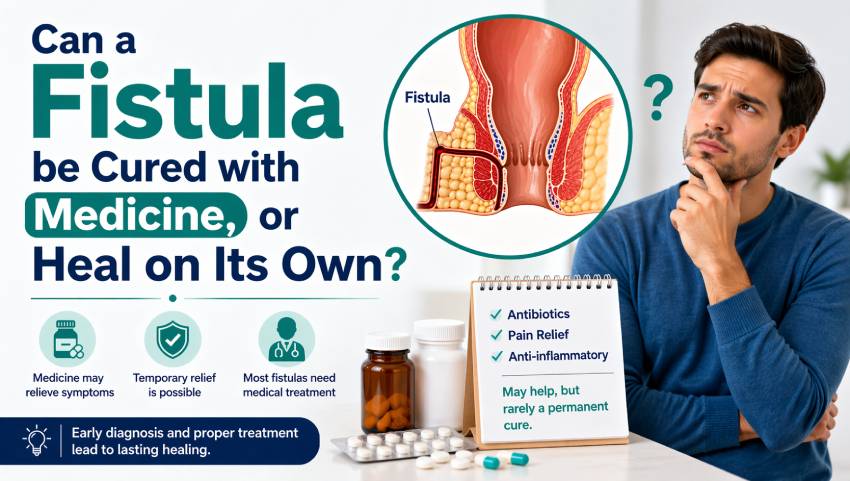
Can a Fistula be Cured with Medicine, or Heal on Its Own?
If you or someone close to you has been diagnosed with a fistula, the very first question that comes to mind is — do I really need surgery? Can a fistula be cured with medicine, or will it heal on its own if given enough time? These are completely natural concerns, and you are certainly not alone in asking them.
As the Director and Head of the Department of Surgical Gastroenterology at Kaizen Gastro Care Clinic, PCMC, Dr. Samrat Jankar brings over 17 years of specialized experience to this discussion. Having successfully managed more than 5,000 cases involving piles, fissures, and complex fistulas, he is widely recognized as one of the most skilled Fistula Surgeons in Maharashtra. In the following sections, Dr. Jankar explains the realities of fistula healing and the advanced treatment options available at his center.
In this blog, we will walk you through everything you need to know — what a fistula is, why it happens, whether it can heal without treatment, what role medicines play, and what your real treatment options are in 2026.
What Exactly Is a Fistula? Understanding the Basics:
A fistula is an abnormal tunnel or tract that forms between two body parts that are not normally connected. In the context of colorectal health, an anal fistula is a small channel that develops between the inner lining of the anal canal and the skin around the anus. This tract is typically the result of an infection that has not healed properly.
Why Does a Fistula Happen?
Understanding the causes of fistula in ano is important before exploring treatment options. The most common reasons include:
- Infected anal glands that develop into an abscess and then form a tract
- Crohn’s disease or other inflammatory bowel conditions
- Tuberculosis or sexually transmitted infections
- Previous surgery or trauma in the anal region
- Radiation therapy affecting the pelvic area
- Complications arising from untreated or severe piles (haemorrhoids)
Common Symptoms to Watch Out For:
- Persistent pain and swelling near the anus
- Pus or blood-stained discharge from an opening near the anus
- Itching and irritation in the anal region
- Redness and tenderness of surrounding skin
- Fever and fatigue when an active infection is present
- Pain or discomfort during bowel movements
Fistulas also vary in their complexity. Simple fistulas have a single direct tract, while complex fistulas may have multiple branches, involve the sphincter muscles, or be associated with underlying conditions like Crohn’s disease. The type of fistula plays a major role in deciding the right treatment approach.
Can a Fistula Heal on Its Own? The Honest Medical Truth:
This is the most searched question by patients, and unfortunately, the honest answer is — almost never. A fistula very rarely heals on its own without any form of medical intervention. Here is why:
- The Anal Area Is Bacteria-Rich: The anal canal is constantly exposed to bacteria from stool. Even if the surface skin appears to improve temporarily, the internal tract remains open and vulnerable to reinfection. Every bowel movement introduces bacteria into the tract, making natural healing practically impossible in most cases.
- Poor Blood Supply Slows Down Healing: The tissue surrounding a fistula tract typically has compromised blood supply, which is one of the key factors that slows down natural tissue repair. Without adequate blood flow, the body’s own healing mechanisms simply cannot close the tract effectively.
- The Tract Stays Open and Active: A fistula tract remains an open channel between infected tissue and the skin. As long as this channel exists, it acts as a route for bacteria to enter and pus to drain. Very small, superficial fistulas may occasionally close temporarily, but they almost always recur — often worse than before.
What Happens If You Ignore a Fistula?
Delaying treatment or hoping the fistula will resolve on its own can lead to serious complications:
- Recurrent painful abscesses in the anal and perianal region
- Progression from a simple fistula to a complex, multi-tract fistula
- Risk of bowel incontinence in advanced cases where sphincter muscles are involved
- Spread of infection to surrounding tissues and organs
- In rare and severe cases — sepsis, which is a life-threatening condition
- Significant deterioration in quality of life and daily functioning
So, is perianal fistula dangerous? Yes — if left untreated, it most certainly can be. The earlier you seek proper medical evaluation, the better your chances of successful treatment with a minimally invasive approach.
Can Medicines Cure a Fistula? What They Can and Cannot Do?
One of the most common misconceptions patients carry is that a course of antibiotics or some ointment will eventually cure their fistula. Let us be very clear about what medicines can and cannot do.
What Medicines Can Do:
- Antibiotics can help control active bacterial infection and reduce swelling
- Topical ointments containing zinc oxide or hydrocortisone can ease pain and irritation of surrounding skin
- Pain relievers such as ibuprofen or paracetamol can make day-to-day discomfort more manageable
- Stool softeners can help reduce strain during bowel movements, preventing further irritation of the tract
What Medicines Cannot Do:
- Medicines cannot close or permanently seal the fistula tract
- Antibiotics cannot eliminate the source of infection once a fistula tract has formed
- No topical or oral medication has been shown to achieve complete and permanent healing of a fistula
- Without addressing the tract physically, any symptomatic relief from medicines is temporary
Medicines are genuinely useful as supportive care — before a procedure, during recovery, or when a patient cannot undergo treatment immediately due to other health reasons. However, they should never be used as a long-term substitute for definitive treatment. If you are looking into how to treat a fistula without surgery, medicines alone are not the answer.
Important: Please never self-medicate. All medicines for fistula management must be taken only under the supervision of a qualified doctor.
Non-Surgical Treatment Options for Fistula — What Actually Works?
If you are wondering how fistula can be cured without surgery, or at least with minimal surgical intervention, the good news is that modern medicine offers several options — especially for early-stage or low-grade fistulas. The key phrase here is “without major open surgery” rather than “without any procedure.”
At Kaizen Gastro Care Clinic, Best Gastroenterologist in pune Dr. Samrat Jankar evaluates each patient individually and recommends the most appropriate approach based on the type, complexity, and location of the fistula.
Ksharsutra Treatment in Pune (Ayurvedic Parasurgical Therapy):
Ksharsutra therapy is one of the oldest and most validated non-surgical approaches for fistula-in-ano. It involves threading a specially medicated Ayurvedic thread through the fistula tract. This thread gradually cuts through the tissue while simultaneously promoting healing and preventing infection. It is minimally invasive, requires no general anaesthesia, and has a notably low recurrence rate even for complex fistulas. Ksharsutra Treatment in Pune at Kaizen Gastro Care Clinic is performed under careful medical supervision, ensuring patient safety throughout the process.
Fistulotomy Treatment in Pune:
Fistulotomy is the most commonly performed procedure for simple anal fistulas. It involves surgically opening the fistula tract and allowing it to heal from the inside out. It has a very high success rate for straightforward cases and is typically performed as a day-care procedure. Fistulotomy Treatment in Pune at our clinic is tailored to minimise tissue removal and protect sphincter function.
3. LIFT Procedure Treatment in Pune (Ligation of Intersphincteric Fistula Tract):
The LIFT procedure is a sphincter-preserving technique ideal for fistulas involving the sphincter muscles. The surgeon accesses the intersphincteric space and ligates (ties off) the fistula tract without cutting through the sphincter. This significantly reduces the risk of incontinence while effectively treating the fistula. LIFT Procedure Treatment in Pune is available at Kaizen Gastro Care Clinic for suitable candidates.
4. FiLaC Procedure Treatment in Pune (Fistula Laser Closure):
FiLaC is a modern, minimally invasive laser-based technique where a laser fibre is introduced into the fistula tract to destroy the epithelial lining and seal the tract from within. It involves no cutting, causes minimal blood loss, and offers a faster recovery compared to traditional surgery. FiLaC Procedure Treatment in Pune is one of the most sought-after options for patients looking for a near-surgery-free experience.
5. VAAFT Procedure Treatment in Pune (Video Assisted Anal Fistula Treatment):
VAAFT uses a miniature camera (fistuloscope) to visualise the fistula tract from the inside, allowing the surgeon to precisely identify all tracts and treat them directly under vision. It is particularly effective for complex or recurrent fistulas. VAAFT Procedure Treatment in Pune is a highly accurate technique that reduces the chances of missing secondary tracts, which is a common cause of recurrence.
6. Fistula Plug Treatment in Pune:
A bioabsorbable fistula plug made from collagen or similar material is inserted into the tract to block it and encourage the body’s natural tissue to close the opening. It is a sphincter-sparing, low-risk option. Fistula Plug Treatment in Pune is generally recommended for uncomplicated fistulas in patients who want to avoid conventional surgery.
7. PILTEC Procedure in Pune:
PILTEC (Pilonidal and Fistula Treatment by Endoscopic Closure) is a relatively newer endoscopic technique that allows treatment of fistulas with minimal incisions and maximum precision. PILTEC Procedure in Pune is available for suitable patients at Kaizen Gastro Care Clinic and represents the latest advancement in without-operation fistula treatment philosophy.
Home Remedies and Lifestyle Changes — Can They Help?
While home remedies will not cure a fistula, they absolutely play a supportive role in managing symptoms and improving comfort, especially before or after treatment. Here is what can genuinely help:
- Sitz Baths: Soaking the anal area in warm water for 10 to 15 minutes, two to three times a day, can significantly reduce inflammation, soothe pain, and keep the area clean. Adding a spoonful of Epsom salt or a mild antiseptic solution enhances the benefit.
- High-Fibre Diet: Eating fibre-rich foods such as whole grains, leafy vegetables, fruits like papaya and banana, and psyllium husk helps soften stools and reduces the strain during bowel movements. This prevents unnecessary pressure on the already sensitive anal region.
- Adequate Hydration: Drinking at least two to three litres of water daily keeps stools soft and bowel movements regular, minimising irritation of the fistula tract.
- Good Hygiene Practices: Keeping the anal region clean and dry is essential to reduce bacterial contamination. Use mild, unscented soap and gently pat the area dry after washing. Avoid vigorous scrubbing that can aggravate the skin.
- Turmeric and Aloe Vera (Supportive Use Only): Turmeric contains curcumin, a natural anti-inflammatory compound. Consuming warm turmeric milk before bed may help support your body’s immune response. Aloe vera gel can be applied externally to soothe skin irritation. However, it is important to understand that these are supportive remedies — not cures.
Remember: Home remedies can make you more comfortable, but they cannot close the fistula tract or eliminate the source of infection.
When Does a Fistula Require Surgery?
The majority of fistulas will require some form of procedural intervention to achieve complete and lasting healing. The type of intervention depends on the fistula’s complexity, location, and the patient’s overall health. Dr. Samrat Jankar carefully assesses each patient before recommending any approach, prioritising sphincter preservation and minimal invasiveness wherever possible.
Signs that surgical or procedural treatment cannot be further delayed:
- Recurring abscesses in the same area, despite antibiotics
- Worsening pain and increasing discharge
- Complex fistula with multiple tracts detected on imaging
- Signs of spreading infection such as fever, chills, and fatigue
- No improvement after initial conservative management
Modern surgical techniques for fistula are far less invasive than they used to be. With advanced options like FiLaC, VAAFT, and the LIFT procedure available at Kaizen Gastro Care Clinic, most patients can expect a smooth recovery and return to normal activities fairly quickly.
Risks of Ignoring or Delaying Fistula Treatment:
Many patients in India delay seeking treatment due to social embarrassment, fear of surgery, or the hope that the condition will resolve on its own. This delay can be costly to your health. Here is what prolonged neglect of a fistula can cause:
- Chronic, daily pain that disrupts sleep, work, and personal relationships
- Repeated hospital visits for recurrent abscesses that keep returning
- Progressive damage to the sphincter muscles, potentially leading to bowel incontinence
- Psychological distress, anxiety, and reduced quality of life
- In rare cases — fistula-associated cancer, especially in long-standing untreated fistulas
- Greater complexity of the fistula over time, making even minimally invasive treatment harder
The message is simple — early treatment means simpler treatment. A fistula caught in its early stages has a much greater chance of being managed with a minimally invasive or non-surgical procedure.
When Should You See a Doctor?
Do not wait for the pain to become unbearable. Visit a specialist immediately if you notice any of the following:
- Persistent pain, swelling, or lump near the anus lasting more than a few days
- Any form of pus or blood-like discharge from the anal or perianal area
- A previous abscess in the same area that seems to have returned
- Fever accompanied by anal discomfort
- Difficulty or pain during or after bowel movements
- Itching, redness, or irritation around the anus that does not resolve with hygiene measures
Early diagnosis dramatically improves the success rate of non-surgical and minimally invasive procedures. As Dr. Samrat Jankar often tells his patients — the sooner you act, the more options you have, and the gentler those options can be.
Conclusion — The Bottom Line on Fistula and Self-Healing
To summarise everything discussed in this blog: a fistula almost never heals on its own, and medicines alone cannot cure it. While antibiotics and topical treatments are helpful in managing symptoms and controlling infection, they do not address the root problem — the open fistula tract that continuously serves as a breeding ground for bacteria.
The good news is that modern Fistula Treatment in Pune has come a long way. From minimally invasive options like FiLaC, VAAFT, LIFT, Ksharsutra, and Fistula Plug, to proven procedures like Fistulotomy — there are effective solutions available for every type and complexity of fistula. The key is to get a proper diagnosis and begin treatment before the condition worsens.
If you are in Pune or nearby areas and are looking for a trusted Fistula Specialist in pune, reach out to Dr. Samrat Jankar at Kaizen Gastro Care Clinic. With over 17 years of expertise, more than 5,000 successful colorectal procedures, and a patient-first approach, Dr. Jankar will guide you to the most appropriate treatment — with minimal pain and maximum results.
Your health is your greatest investment. Do not delay. Book your consultation with Best Gastroenterologist in pune today.
Frequently Asked Questions (FAQ's):
In very rare cases, a tiny, superficial fistula may appear to close temporarily. However, without medical treatment, it almost always recurs, often becoming more complex. Professional evaluation is always recommended.
Yes, in selected early-stage cases, non-surgical and minimally invasive options like Ksharsutra therapy, FiLaC, or Fistula Plug can be used to treat fistula without conventional open surgery. However, some form of procedural intervention is usually necessary.
Healing time varies based on the method used and the complexity of the fistula. Minimally invasive procedures may show results within a few weeks to a few months. Regular follow-up with your doctor is essential throughout the healing journey.
Ksharsutra causes minimal discomfort and is generally well-tolerated by patients. Local anaesthesia is used during the initial insertion of the thread, and patients can typically resume their daily routine without major restrictions.
Recurrence is common if the underlying infection source is not completely addressed, secondary tracts are missed during treatment, or the patient has an underlying condition like Crohn’s disease. Advanced techniques like VAAFT are specifically designed to identify and treat all tracts under direct vision to reduce recurrence.
You should consult a Surgical Gastroenterologist or Colorectal Surgeon with specialised experience in anorectal disorders. In Pune, Dr. Samrat Jankar at Kaizen Gastro Care Clinic, PCMC, is a highly recommended specialist with over 17 years of experience and 5,000+ successful procedures in this field.