
- 09/10/2024
- Dr Vikrant Kale
- 0 Comments
- Gut Health
Bowel Obstruction: Symptoms, Causes, and When to Seek Immediate Care
Have you or someone you know suddenly experienced severe abdominal cramping, inability to pass gas, a bloated stomach, and vomiting — all at once? These are classic warning signs of a bowel obstruction, a serious medical condition that demands immediate attention.
At Kaizen Gastro Care, Pune’s trusted centre for advanced gastroenterology and GI surgery, our specialists — including experienced gastroenterologist and GI surgeon Dr. Samrat Jankar — treat bowel obstructions regularly. In this guide, we explain everything you need to know: what a bowel obstruction is, its symptoms, causes, types, diagnosis, treatment, and most importantly — when to rush to the hospital.
What is Bowel Obstruction?
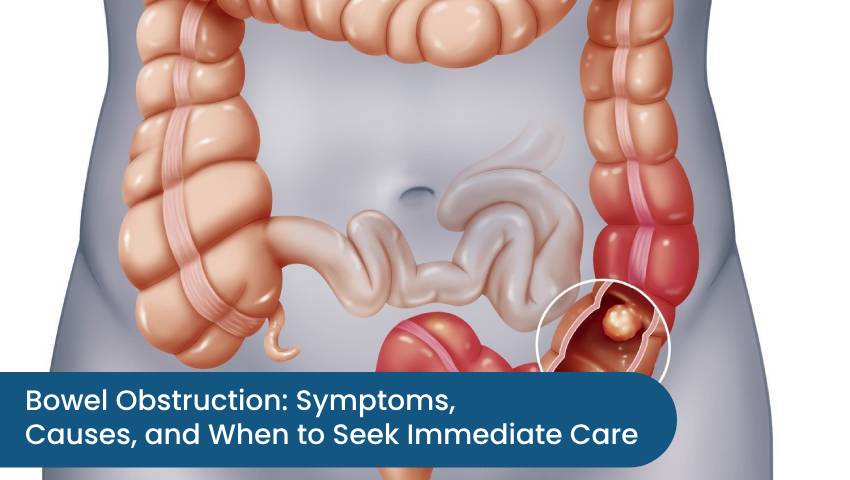
A bowel obstruction (also called intestinal obstruction) is a partial or complete blockage inside your small intestine or large intestine (bowel/colon) that prevents food, liquids, and gas from passing through normally.
When the intestine is blocked, everything behind the blockage — waste, digestive juices, and gas — gets trapped. This build-up increases pressure inside the intestine, damages the intestinal wall, and can cut off blood supply. Left untreated, a bowel obstruction can become life-threatening within hours.
This is not something to “wait and watch.” A bowel obstruction is a medical emergency.
Types of Bowel Obstruction
Understanding the type helps in faster diagnosis and treatment. At Best Gastro in Pune – Kaizen Gastro Care, our GI specialists classify bowel obstructions based on location, severity, and cause.
1. Small Bowel Obstruction (SBO)
The most common type — approximately 80% of all intestinal obstructions occur in the small intestine. The small intestine connects your stomach to the large intestine and is responsible for nutrient and water absorption. When blocked here, the consequences are rapid and severe.
2. Large Bowel Obstruction (LBO)
Accounts for about 20% of intestinal blockages. The large intestine (colon and rectum) processes and eliminates waste. Large bowel obstructions are strongly associated with colon cancer — in fact, nearly 40% of colon cancer patients are first diagnosed because bowel obstruction symptoms brought them to emergency care.
3. Partial vs Complete Obstruction
- Partial obstruction — The intestine is narrowed but not fully blocked. Some gas or stool may still pass. Symptoms are present but less severe.
- Complete obstruction — The intestine is fully blocked. No gas or stool can pass. This is a surgical emergency.
4. Strangulated Bowel Obstruction
The most dangerous type. Here, the blood supply to a section of the intestine is cut off entirely. The intestinal tissue begins to die (necrosis) within hours. This requires emergency surgery. At Kaizen Gastro Care, our GI surgical team is equipped for round-the-clock emergency intestinal surgeries.
5. Pseudo-Obstruction (Ileus)
A “false obstruction” where the intestine behaves as if blocked — with all the symptoms — but there is no physical blockage. It is caused by nerve dysfunction in the intestine, often following surgery, serious illness, or certain medications.
Bowel Obstruction Symptoms: What to Look For
Common Symptoms of Small Bowel Obstruction
- Severe abdominal cramping that comes in waves (every few minutes), then becomes constant
- Bloating and abdominal distension — your belly visibly swells
- Nausea and vomiting — sometimes vomit can be green, yellow, or even foul-smelling (feculent) in advanced cases
- Inability to pass gas or stool (complete obstruction)
- Diarrhea in some cases of partial blockage
- Loss of appetite
- Rapid heartbeat and signs of dehydration — dark urine, dry mouth, dizziness
Symptoms of Large Bowel Obstruction (Colon Blockage)
- Continuous, widespread abdominal pain rather than wave-like cramping
- Severe constipation progressing to inability to pass anything
- Massively bloated abdomen
- Vomiting (appears later than in small bowel obstruction)
Symptoms in Infants and Children
Children and babies cannot describe their pain — watch for these signs:
- Pulling legs up toward the belly and crying inconsolably
- Green or yellow-green vomit
- Blood in stool (rectal bleeding)
- Swollen, firm belly
- Fever
- Unusual lethargy
Important: If you or your child is showing any combination of the above symptoms, do not wait. Contact Kaizen Gastro Care immediately at 097 6363 5252 or visit ourKaizen Gastro Care clinic in Wakad, Pune.
What Does a Bowel Obstruction Feel Like?
Patients often describe the pain as feeling like “someone is squeezing and twisting my intestines.” Here’s what to expect:
- Small bowel obstruction pain — sharp, intermittent cramping that comes in short waves every few minutes. It is usually concentrated in one area of the abdomen.
- Large bowel obstruction pain — more diffuse, constant cramping spread across the lower abdomen.
- Strangulated obstruction pain — sudden, severe, unrelenting pain. This is a red flag for emergency surgery.
The combination of cramping pain + bloating + vomiting + inability to pass gas is the classic “triad” that should send you directly to a gastroenterologist or emergency department.
Causes of Bowel Obstruction:
Bowel obstruction symptoms can stem from several different underlying causes. At Kaizen Gastro Care, identifying the exact cause determines the treatment approach.
Most Common Causes of Small Bowel Obstruction
- Intestinal Adhesions (Scar Tissue):
The single most common cause — accounting for 60–70% of small bowel obstructions. Adhesions are bands of scar tissue that form after abdominal surgery (appendectomy, gallbladder removal, hernia repair, etc.). They can pull or kink the intestine, causing blockage years after the original surgery. - Hernias:
An inguinal, umbilical, incisional, or internal hernia can trap a loop of intestine, causing it to become blocked or strangulated. At Kaizen Gastro Care, Dr. Samrat Jankar specializes in advanced laparoscopic hernia repair to prevent this complication. - Crohn’s Disease (IBD):
Chronic inflammation in Crohn’s disease leads to intestinal wall thickening, strictures (narrowing), and eventually complete blockage over time. - Intussusception:
A condition where one section of intestine telescopes into an adjacent section — common in children under 3 years old. Requires immediate medical attention. - Volvulus:
The intestine twists around itself, cutting off both the passageway and blood supply. A twisted bowel or twisted intestine is a surgical emergency.
Most Common Causes of Large Bowel Obstruction
- Colon Cancer:
The number one cause of large bowel obstruction in adults. A growing tumour gradually narrows the colon until it causes a complete blockage. This is why regular colonoscopy screening is critical — early detection prevents emergency presentations. - Diverticular Disease:
Inflammation or scarring from diverticulitis can narrow the colon, causing partial or complete obstruction. - Colonic Volvulus:
Twisting of the sigmoid colon or caecum — more common in elderly patients and those with chronic constipation. - Faecal Impaction:
Severely hardened stool that blocks the colon entirely — more common in elderly patients, those on opioid medications, or those with severe chronic constipation.
When to Seek Immediate Care — Do Not Wait
Go to emergency care or call Kaizen Gastro Care immediately at 09763635252 if you experience:
- Sudden, severe abdominal pain that does not ease
- Complete inability to pass gas or have a bowel movement
- Vomiting that is green, brown, or foul-smelling
- A visibly swollen, rigid abdomen
- Fever with abdominal pain
- Signs of shock — rapid heartbeat, pale skin, confusion, dizziness
A bowel obstruction does not resolve on its own. Every hour of delay increases the risk of life-threatening complications.
How Is Bowel Obstruction Diagnosed?
At Kaizen Gastro Care, our specialists use a structured diagnostic approach to confirm bowel obstruction quickly and accurately:
- Physical Examination
Dr. Samrat Jankar will examine the abdomen for distension, rigidity, tenderness, and the presence or absence of bowel sounds (a hyperactive “tinkling” sound on a stethoscope is a classic sign of obstruction). - Abdominal X-Ray
The first-line imaging test. An abdominal X-ray showing dilated bowel loops with air-fluid levels is the classic radiological sign of intestinal obstruction. - CT Scan of the Abdomen
The gold standard for bowel obstruction diagnosis. A CT scan identifies the exact location, cause, and severity of the blockage — and importantly, detects signs of strangulation (dead tissue). - Blood Tests
Elevated white blood cell count, raised inflammatory markers, and metabolic abnormalities indicate severity and help guide urgent surgical decisions. - Colonoscopy
Used selectively to both diagnose and sometimes treat large bowel obstructions (e.g., placing a stent to relieve a colon cancer blockage as a bridge to surgery).
Bowel Obstruction Treatment: What Are the Options?
Treatment depends on the type, cause, severity, and whether blood supply is compromised. At Kaizen Gastro Care, our GI surgical team handles everything from conservative management to emergency surgery.
Conservative (Non-Surgical) Management
Used for partial obstructions or pseudo-obstructions:
- Nil by mouth (NBM) — fasting to rest the bowel
- Nasogastric (NG) tube — inserted through the nose into the stomach to drain trapped gas and fluids, relieving pressure
- IV fluids and electrolyte correction — dehydration is aggressively managed
- Close monitoring — the patient is observed for improvement or deterioration
Surgical Treatment
Required for complete obstructions, strangulation, or failed conservative management:
- Laparoscopic surgery — minimally invasive, preferred approach at Kaizen Gastro Care for adhesion release, hernia repair, and volvulus correction
- Bowel resection — removal of the blocked or dead section of intestine, followed by reconnection or a temporary stoma
- Colonic stenting — for colon cancer causing obstruction, a metal stent can be placed endoscopically to relieve the blockage as a “bridge to surgery”
- Emergency open surgery — required in cases of perforation, peritonitis, or strangulation with bowel death
At Kaizen Gastro Care, Dr. Samrat Jankar performs advanced laparoscopic GI surgeries including adhesiolysis, hernia repair, colonic resection, and emergency bowel surgery — all under one roof at our Wakad, Pune clinic.
How Kaizen Gastro Care Treats Bowel Obstruction in Pune
Kaizen Gastro Care, located at Wakad, Pune, is one of the most comprehensive gastroenterology and GI surgery centres in Pune and PCMC. Our team brings together:
- Dr. Samrat Jankar — experienced GI and laparoscopic surgeon with expertise in emergency bowel surgery, hernia repair, colorectal surgery, and adhesiolysis
- Dr. Vikrant Kale — gastroenterologist and liver specialist managing the medical aspects of GI conditions including Crohn’s disease and IBD-related obstructions
- On-site diagnostics — X-ray, CT scan, colonoscopy, and endoscopy available for rapid assessment
- Full surgical facility — laparoscopic and open GI surgery capabilities for both elective and emergency cases
We treat patients from across Pune, Pimpri-Chinchwad, Wakad, Hinjewadi, Baner, Aundh, and the wider PCMC region.
Conclusion:
A bowel obstruction — whether a blocked intestine, obstructed bowel, twisted colon, or intestinal blockage — is never a minor issue. From the first wave of severe abdominal cramping to the inability to pass gas, the symptoms are your body’s urgent signal to seek expert medical care.
At Kaizen Gastro Care, Pune, our experienced GI specialists and surgeons are equipped to diagnose and treat all types of bowel obstructions — quickly, safely, and effectively.
Do not wait. Call us today at 097 6363 5252 or book an appointment online.
Frequently Asked Questions About Bowel Obstruction
With a partial obstruction, it may still be possible — but with great difficulty. With a complete obstruction, passing stool or gas becomes impossible. Any change in your normal bowel pattern alongside pain and bloating warrants urgent evaluation.
A complete or strangulated obstruction can become fatal within 24–72 hours without treatment. Even a partial obstruction should be evaluated within 24 hours as it can worsen rapidly.
Constipation involves difficulty passing stool but no physical blockage. Bowel obstruction involves a structural or mechanical blockage preventing movement through the intestine. The pain with obstruction is typically much more severe and is accompanied by vomiting and abdominal distension.
At Kaizen Gastro Care, laparoscopic surgery for bowel obstruction is performed with high precision and minimal recovery time. The safety of surgery depends on how quickly the patient presents — early surgery carries far better outcomes than emergency surgery for a perforated or gangrenous bowel.
The cost depends on whether management is conservative or surgical, and the duration of hospital stay. At Kaizen Gastro Care, our team provides a transparent cost estimate after initial evaluation. Call 097 6363 5252 for details.