
- 28/04/2026
- Dr Vikrant Kale
- 0 Comments
- Digestive Disorder
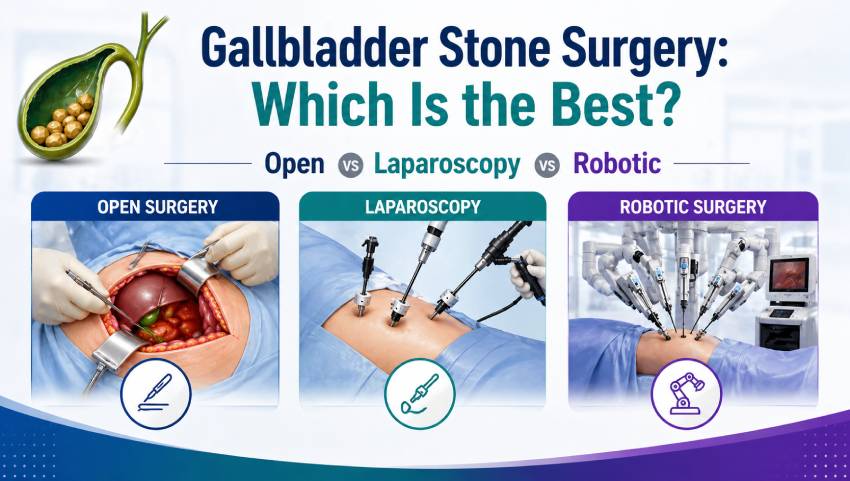
Gallbladder Stone Surgery: Which Is the Best? Open vs Laparoscopy vs Robotic
If you or someone in your family has been told that gallbladder stones or a gallbladder polyp needs surgery, the very first question that comes to mind is — which surgery is the right one? Should it be the traditional open method? Or the keyhole laparoscopic approach? And now there is robotic surgery too — so which one is truly the best?
If you have been searching for answers about Gallbladder Stone Surgery in Pune, you are in the right place. Dr. Samrat Jankar, one of the most trusted and best Gastroenterologist in Pune, breaks down all three surgical options in simple, easy-to-understand language — so you can make a well-informed decision for yourself or your loved ones.
Dr. Samrat Jankar is the Director & Head of the Department of Surgical Gastroenterology at Kaizen Gastro Care Clinic, PCMC, Pune. With over 17 years of experience in advanced laparoscopic and colorectal surgeries, he has successfully managed more than 1,000 cases of Laparoscopic Surgeries, making him one of the most experienced Laparoscopic Surgeons in Pune and a leading Best Robotics GI Surgeon in Pune.
Now let us understand each surgical option clearly.
Watch the Full Explanation by Dr. Samrat Jankar:
“Understanding your surgical options before going into the operation theatre makes you a more confident and prepared patient.” — Dr. Samrat Jankar
Why Is the Entire Gallbladder Removed?
Before we compare the three types of surgeries, it is important to understand one fundamental thing: when it comes to gallbladder stones or polyps, doctors do not just remove the stone or the polyp alone. The entire gallbladder is removed.
Why? Because the gallbladder itself has stopped functioning properly — that is what caused the stones to form in the first place. If only the stones are removed, new stones can form again, and you may end up needing a second surgery. So worldwide, the standard treatment is to remove the entire gallbladder along with the stones. This procedure is called a Cholecystectomy.
Now the question is — which type of cholecystectomy is best for you?
Open Surgery — Open Cholecystectomy:
What Is Open Cholecystectomy?
Open Cholecystectomy is the traditional, time-tested surgical method that has been performed for decades. In this procedure, the surgeon makes a 5 to 6 inch incision below the right rib cage, cuts through the muscles, and removes the gallbladder directly.
Is Open Surgery Wrong or Outdated?
Not at all. Open surgery is absolutely necessary in certain situations — and it remains a safe and valid option in those cases even today.
Open surgery is recommended when:
- The gallbladder is severely complicated or deeply embedded
- The patient cannot tolerate CO2 gas used in keyhole surgeries (for example, in patients with heart conditions or very low blood pressure)
- Laparoscopic equipment or expertise is not available locally
What Are the Drawbacks of Open Surgery?
While open surgery is sometimes the only option, it does come with notable downsides:
- Significant post-operative pain due to the large incision
- Risk of hernia at the incision site
- Risk of infection and bleeding
- Long recovery time — patients typically stay in the hospital for 5 to 6 days
- Visible scarring that may remain prominent
Verdict on Open Surgery:
In today’s modern era, open cholecystectomy is limited to specific cases where laparoscopic surgery is not feasible. It is not the default choice anymore. But where there is no other option, it remains a safe and necessary procedure.
Laparoscopic Surgery — The Current Gold Standard
What Is Laparoscopic Cholecystectomy?
Laparoscopic Cholecystectomy — commonly known as keyhole or minimally invasive surgery — is currently the most widely performed and recommended method for gallbladder removal across India and worldwide.
Instead of making a large incision, the surgeon creates four small puncture holes in the abdomen — two of 10mm and two of 5mm. The abdomen is gently inflated with CO2 gas to create space, a tiny camera is inserted, and the gallbladder is removed through those same small openings. You can barely see the marks afterwards.
Today, laparoscopy to remove gallbladder is available not just in big cities but also in smaller towns and district hospitals across Maharashtra and all of India.
Why Did Laparoscopic Surgery Become So Popular?
The shift from open to laparoscopic surgery happened over the last 25 to 50 years because laparoscopy dramatically reduced all the major problems associated with the open technique — pain, recovery time, scarring, and complications.
Benefits of Laparoscopic Gallbladder Removal:
- Minimal pain after surgery
- Very little blood loss
- Patient can go home the very next day in most cases
- Tiny, barely visible scars on the abdomen
- Covered by most health insurance plans
- Widely available — even in smaller towns.
Verdict on Laparoscopy:
Robotic Surgery — The Latest Innovation in Gallbladder Surgery
What Is Robotic Gallbladder Surgery?
Think of robotic surgery as the next generation of laparoscopic surgery — like upgrading from a basic smartphone to the latest iPhone. The surgeon still performs the operation, but is now assisted by a highly sophisticated robotic system that enhances precision, vision, and safety to a whole new level.
A common misconception is that a robot operates on its own. That is not the case. The surgeon is in full control throughout the procedure — the robotic arms simply translate the surgeon’s movements with far greater precision than human hands alone.
How Is Robotic Surgery Better Than Laparoscopy?
Here is why robotic surgery is considered the most advanced option available today:
- 10 times better vision compared to standard laparoscopy
- 3D vision versus the 2D view in laparoscopic procedures — giving the surgeon far greater depth and clarity
- Tremor filtering — if the surgeon’s hands tremble even slightly due to fatigue, the robotic system filters it out, so the patient is never affected
- Firefly / ICG Mode — a special imaging mode that helps the surgeon clearly see the bile duct during surgery, significantly reducing the risk of accidental bile duct injury
- Greater surgical effectiveness in complicated cases, obese patients, and even routine gallbladder surgeries
- Lower risk of complications like bile duct injury, bleeding, or damage to nearby organs
Dr. Samrat Jankar, recognised as one of the Best Robotics GI Surgeons in Pune, uses robotic technology to ensure maximum safety and precision for every patient.
What Are the Limitations of Robotic Surgery?
Robotic surgery is cutting-edge, but it does have some practical limitations:
- It has been widely developed only in the last 5 to 10 years, so expertise is not available at every centre
- The technology is expensive, so it is not available everywhere — mainly limited to advanced surgical hospitals in major cities
- Cost is higher than laparoscopic surgery
- Not all insurance companies fully cover robotic surgery; some offer partial coverage only
Verdict on Robotic Surgery:
If you have access to an experienced robotic surgeon, the technology is available nearby, and it is financially feasible — then robotic surgery is the best option for gallbladder removal currently available. It offers the highest safety, the best vision, and the lowest risk of complications.
Side-by-Side Comparison: Open vs Laparoscopy vs Robotic
So Which Surgery Should You Choose?
Here is a simple, practical guide to help you decide:
Step 1: Visit a qualified expert — an experienced Laparoscopic Surgeon in Pune or a Robotic GI Surgeon — and get a proper consultation.
Step 2: Take a second opinion if needed. There is nothing wrong with seeking one — in fact, it is encouraged.
Step 3: Discuss these questions with your doctor:
- Is laparoscopic or robotic surgery suitable for my condition?
- Is robotic technology available at the hospital?
- Does my surgeon have experience with robotic procedures?
- Is the cost and insurance coverage feasible for me?
Step 4: Based on your answers, make a decision:
- If robotic surgery is accessible and affordable → Go for Robotic
- If robotic is not feasible → Laparoscopic Cholecystectomy in expert hands is an excellent choice
- If neither is possible due to medical complications → Open Cholecystectomy remains a valid, safe option
Important: Conversion to Open Surgery Is NOT a Failure
There is one more thing every patient should know. In about 1% of laparoscopic or robotic surgeries, the surgeon may need to convert to open surgery mid-procedure. This does not mean the surgery has failed or gone wrong.
Your surgeon converts to open surgery purely for your safety — if there is unexpected bleeding, unusual anatomy, or other intraoperative challenges. Trust your surgeon’s judgement. It is always done in your best interest.
Expert Gallbladder Stone Surgery in Pune — Consult Dr. Samrat Jankar:
If you or a family member is experiencing symptoms of gallstones or has been diagnosed with a gallbladder polyp, do not delay seeking expert advice. Early treatment with the right surgical approach can make a significant difference to your recovery and quality of life.
Dr. Samrat Jankar, with over 17 years of surgical expertise, more than 1,000 successful laparoscopic procedures, and advanced training in robotic GI surgery, is among the most trusted names for Gallbladder Stone Surgery in Pune. At Kaizen Gastro Care Clinic, PCMC, Pune, you receive world-class care with the latest technology — tailored to your individual needs.
Whether you need a Laparoscopic Cholecystectomy or are exploring robotic options, the right guidance is just one appointment away.
Frequently Asked Questions (FAQ's):
While certain medicines may help manage symptoms temporarily, they cannot permanently resolve gallstones. The risk of recurrence is high without surgical removal of the gallbladder.
A standard Laparoscopic Cholecystectomy typically takes 30 to 60 minutes under general anaesthesia.
Yes. The liver continues to produce bile, which aids digestion. Most patients return to a normal diet within a few weeks after surgery.
Yes. Robotic surgery actually reduces the risk of complications compared to conventional laparoscopy, thanks to tremor filtering, 3D vision, and advanced imaging modes like Firefly/ICG.
Laparoscopic Cholecystectomy is covered by most health insurance policies in India. Robotic surgery coverage varies by insurer — some offer partial coverage.