
- 21/05/2025
- Dr Vikrant Kale
- 0 Comments
- Digestive Disorder
Belly Button Pain (Periumbilical Pain): Causes, Treatment and When to See a Doctor?
That sudden ache around your belly button — also called periumbilical pain or navel pain — is something almost all of us have felt at some point. Sometimes it passes in a few minutes. Other times, it keeps coming back and you start wondering: is this serious?
The belly button (umbilicus) sits at the centre of your abdomen, surrounded by the small intestine, large intestine, appendix, stomach, and in women, the reproductive organs. So when something goes wrong in any of those organs, you often feel it around or near the navel first.
In this article — written by our gastroenterology specialists at Kaizen Gastro Care, Pune — we cover all the major causes of belly button pain, what the location of pain tells you, special concerns for women and pregnant women, and clear red flags that mean you should see a doctor right away.
What Does the Location of Your Belly Button Pain Tell You?
Not all belly button pain is the same. Where exactly it hurts gives your doctor important clues about what organ might be involved. Here is a quick guide:
- Pain Above the Belly Button
Pain in the area above the navel usually points to the stomach or upper digestive tract. Common causes include gastritis, acid reflux, peptic ulcers, or hiatal hernia. If you also feel burning or nausea, acidity or ulcers are very likely. - Pain Below the Belly Button
Pain below the navel or under the belly button in women often relates to the uterus, ovaries, or bladder. In men, it can indicate a bladder or bowel issue. Conditions like UTI, constipation, or endometriosis typically cause this type of discomfort. - Pain to the Right Side of the Belly Button
Right-side belly button pain is the most important one to take seriously. Early appendicitis classically begins as dull pain near the navel and then shifts to the lower right. An umbilical hernia that has moved can also cause right-sided discomfort. - Pain to the Left Side of the Belly Button
Left-side belly button pain is commonly linked to IBS (Irritable Bowel Syndrome), constipation, diverticulitis, or in women, an ovarian cyst on the left side. It tends to come and go with meals or bowel habits. - Pain Behind or Deep Inside the Belly Button
Deep or internal navel pain — pain that feels like it is coming from inside the belly button — is usually caused by an umbilical hernia, a cyst, or an infection. Rarely, it can point to a serious condition like an aortic aneurysm, which needs urgent attention.
Common Causes of Belly Button Pain
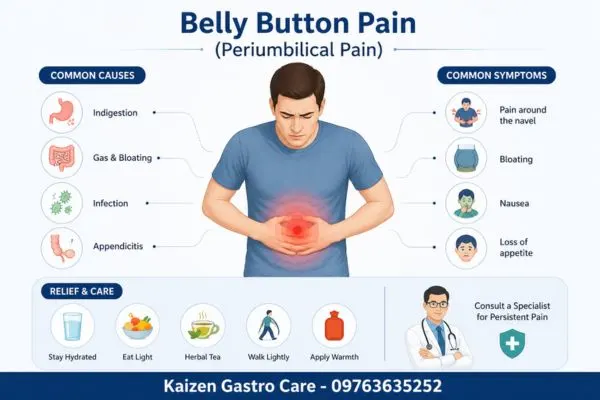
Here are the most frequent reasons for pain around or near the belly button:
- Appendicitis
Appendicitis is one of the most important causes to rule out. It almost always starts as a dull, crampy pain near the navel that gradually shifts to the lower right abdomen over a few hours. If you have this pattern along with fever, nausea, or vomiting, go to a hospital immediately — appendicitis can be life-threatening if the appendix ruptures. - Umbilical Hernia
An umbilical hernia happens when a part of the intestine or fatty tissue pushes through a weak spot in the abdominal wall near the navel. You may notice a soft lump near or inside the belly button, especially when you cough or strain. It can cause a dull ache or a sharp pulling pain in the belly button area. Surgery is usually needed if it grows or becomes painful. - IBS (Irritable Bowel Syndrome)
IBS is one of the most common causes of recurring stomach pain near the navel. The pain is usually crampy, comes and goes, and is often related to meals or stress. It may be accompanied by bloating, diarrhoea, or constipation. IBS does not damage the intestine but it significantly affects quality of life. - Gastroenteritis (Stomach Infection)
A stomach bug caused by a virus or bacteria can cause crampy pain around the belly button along with loose stools, nausea, and vomiting. It usually resolves in 2–3 days with rest and hydration. If it lasts longer or there is blood in stool, see a doctor. - Urinary Tract Infection (UTI)
UTIs, especially common in women, can cause pain below and around the belly button along with a burning sensation while urinating. Do not ignore UTI symptoms — untreated infections can travel to the kidneys. - Constipation and Bloating
Constipation puts pressure on the intestines, which can cause a tummy ache near the belly button, a sensation of tightness, and general abdominal discomfort. Increasing fibre intake, staying hydrated, and light physical activity usually help. - Crohn’s Disease
Crohn’s is a chronic inflammatory bowel disease that often causes persistent pain in the periumbilical region, along with diarrhoea, weight loss, and fatigue. It requires proper diagnosis and long-term medical management. - Gallstones and Pancreatitis
While gallstone pain typically starts in the upper right abdomen, it can radiate around the navel. Pancreatitis — inflammation of the pancreas — also causes severe upper abdominal or periumbilical pain that often radiates to the back
Belly Button Pain in Women — Special Causes
Women experience belly button pain more frequently than men, largely due to the reproductive organs located in the lower abdomen. If you are a woman experiencing persistent navel pain, these causes deserve special attention:
- Ovarian Cysts: Fluid-filled sacs on the ovary cause pain on the left or right side of the belly button depending on which ovary is affected. The pain can be sharp or dull, and may worsen during menstruation.
- Endometriosis: Tissue similar to the uterine lining grows outside the uterus, causing severe cramping and pain around the navel — especially during periods.
- Menstrual Cramps: Period pain is often felt below and around the belly button as the uterus contracts. This is normal but should not be debilitating.
- Ectopic Pregnancy: If a fertilised egg implants outside the uterus (usually in the fallopian tube), it causes sharp lower abdominal pain and is a medical emergency.
- Pelvic Inflammatory Disease (PID): An infection of the reproductive organs, PID causes lower abdominal and belly button discomfort, often with fever and unusual discharge.
If you are a woman with recurring or worsening belly button pain, it is always worth consulting a gynaecologist or gastroenterologist for a proper evaluation.
Belly Button Infections — Signs, Causes & Treatment
The belly button is a warm, moist fold of skin — a perfect environment for bacteria and fungi to grow, especially if it is not cleaned regularly.
Signs of a Belly Button Infection
- Redness or swelling around the navel
- Discharge (yellow, green, or white) from the belly button
- Foul smell or odour from the navel
- Itching or burning sensation around the belly button
- Pain or tenderness when touched
What Causes It?
Bacterial infections are the most common. Yeast or fungal infections can also occur, especially in people with diabetes or those who are overweight. People with belly button piercings are at higher risk of infection if the piercing site is not kept clean.
Belly Button Infections Treatment
Mild infections can be managed with proper cleaning using mild soap and water, keeping the area dry, and applying an antifungal or antibiotic cream as advised by your doctor. Do not try to squeeze or pick at the navel. If there is fever, severe swelling, or spreading redness, see a doctor — you may need oral antibiotics.
Can a belly button infection be dangerous? In most cases, no — if caught early and treated properly. However, if left untreated, the infection can spread to deeper tissues (cellulitis) or become a serious abscess. Always consult a doctor if symptoms do not improve in 2–3 days.
Pain When You Press the Belly Button
If pressing on your belly button causes pain or tenderness, it usually means there is inflammation or pressure in the structures just below the skin. This is called abdominal tenderness and can indicate:
- Umbilical hernia — especially if you feel a soft bulge
- Local skin or navel infection
- Early appendicitis — the navel area becomes tender before the pain shifts right
- Peritonitis — inflammation of the abdominal lining, which is a medical emergency
If pressing near the belly button causes intense pain or a rigid (board-like) abdomen, go to the emergency room immediately.
Diagnosis and Treatment of Belly Button Pain
How Is It Diagnosed?
At Kaizen Gastro Care, our specialists assess belly button pain through a thorough physical examination, review of your symptoms and medical history, and when needed: blood tests, urine tests, ultrasound, or CT scan of the abdomen.
Belly Button Pain Treatment Options
Treatment depends entirely on the underlying cause:
- Infection: Antibiotics or antifungal medication
- Hernia: Laparoscopic hernia repair surgery
- Appendicitis: Emergency appendix removal (appendicectomy)
- IBS/Gastritis: Dietary changes, antispasmodics, probiotics, stress management
- UTI: Antibiotics prescribed after urine culture
- Constipation: High-fibre diet, hydration, laxatives if needed
- Endometriosis/Ovarian Cysts: Hormonal therapy or laparoscopic surgery
Many causes of belly button pain can be managed with simple lifestyle changes and medications. It is always best not to self-medicate, especially for recurring or worsening pain.
Red Flags — When to See a Doctor Immediately
Do not wait to get checked if you experience any of the following along with belly button or abdominal pain:
- Sudden, severe pain that does not go away
- Pain that starts near the navel and shifts to the lower right (may be appendicitis)
- Fever above 38°C along with abdominal pain
- Blood in vomit or stool
- A hard or rigid abdomen
- A visible lump near the belly button that cannot be pushed back in
- Rapid heartbeat, dizziness, or fainting with abdominal pain
- Severe pain during pregnancy
- Symptoms lasting more than 2–3 days without improvement
These warning signs point to potentially serious conditions — appendicitis, a strangulated hernia, peritonitis, or an ectopic pregnancy — that need emergency medical care.
Final Word from Kaizen Gastro Care
Belly button pain is rarely something to brush off, especially if it is recurring, worsening, or accompanied by other symptoms. The good news is that most causes are treatable when caught early.
At Kaizen Gastro Care, Pune, our team of experienced gastroenterologists and surgeons — including Dr. Samrat Jankar and Dr. Vikrant Kale — specialise in diagnosing and treating all conditions that cause abdominal and periumbilical pain, using advanced diagnostics and minimally invasive techniques.
If you are experiencing belly button pain that is not going away, do not ignore it. Book a consultation with our specialists today.
FAQs On Belly Button Pain
Tenderness when pressing the belly button is usually caused by a hernia, local infection, or early appendicitis. If the pain is severe or the abdomen feels rigid, seek medical attention immediately.
In women, belly button pain can be caused by ovarian cysts, endometriosis, menstrual cramps, PID, or a UTI — in addition to all the general causes like IBS, hernia, and constipation.
Yes, appendicitis typically starts as a dull periumbilical pain that shifts to the lower right abdomen within hours. It is accompanied by fever, nausea, and loss of appetite. This needs emergency treatment.
The growing uterus stretches the abdominal wall, which puts pressure on the navel. This is common and usually harmless. However, severe or persistent pain during pregnancy always needs medical evaluation.
Look for redness, swelling, discharge with an unpleasant smell, and pain or itching around the navel. A mild infection can be treated at home, but worsening symptoms need a doctor.
The periumbilical region refers to the area immediately around the belly button (umbilicus). Pain in this region is called periumbilical pain and has many possible causes from digestive, urinary, and reproductive organs.