
- 09/10/2026
- Dr Vikrant Kale
- 0 Comments
- Digestive Disorder
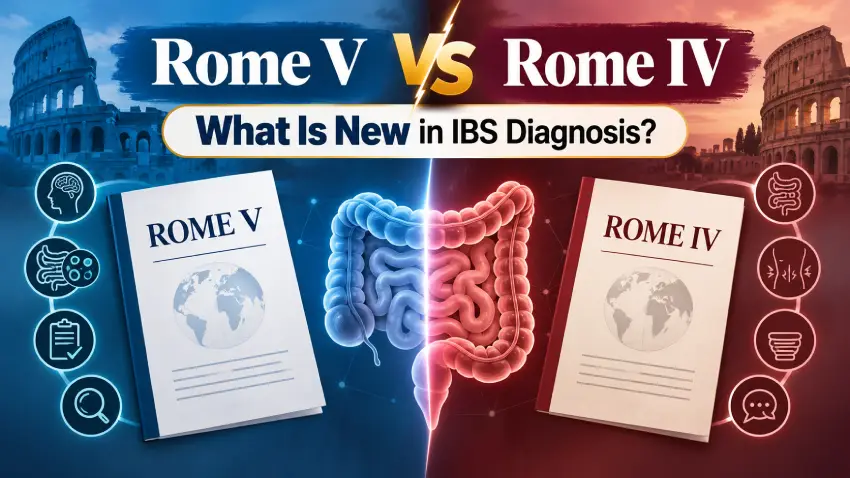
Rome V vs Rome IV: What Is New in IBS Diagnosis?
Rome V is the new 2026 guide for diagnosing irritable bowel syndrome (IBS). It brings back “discomfort” along with pain. It also needs symptoms on just 3 days a month. So, more people with real IBS symptoms can now get a proper diagnosis.
Have you been facing stomach trouble for months? Then this update is good news for you. At Kaizen Gastro Care, many patients tell us they suffered for a long time without clear answers. Let us understand what has changed.
What Are the Rome Criteria for IBS?
The Rome Criteria are guidelines used by doctors to diagnose irritable bowel syndrome and other disorders of gut-brain interaction.
IBS can cause symptoms such as abdominal pain, abdominal discomfort, bloating, constipation, diarrhoea and bowel movement changes. These symptoms can be different from person to person.
The Rome Criteria help doctors understand the patient’s symptoms in a systematic way. They also help doctors decide whether the symptoms fit IBS or if another digestive condition needs to be checked.
Rome IV was widely used for IBS diagnosis. Rome V is the newer update and includes some changes in how IBS symptoms are described and assessed.
Rome IV vs Rome V: Key Differences at a Glance
One of the main changes is the symptom frequency. Rome IV used abdominal pain at least one day per week. Rome V uses abdominal pain or discomfort on average at least three days per month.
What Is New in Rome V IBS Diagnosis?
One important change in Rome V is the inclusion of abdominal discomfort along with abdominal pain.
Many patients may not describe their symptoms as strong pain. They may say they feel heaviness, discomfort, pressure or an uneasy feeling in the stomach or abdomen. Rome V recognises this type of symptom more clearly.
Another important change is the frequency of symptoms.
Under Rome IV, abdominal pain was required at least one day per week. Under Rome V, abdominal pain or discomfort should occur on average at least three days per month.
Rome V also continues to consider changes in bowel movements, stool frequency and stool consistency.
IBS Subtype Classification:
IBS can be divided into different types depending on bowel habits.
- IBS-C: Constipation-predominant IBS
- IBS-D: Diarrhoea-predominant IBS
- IBS-M: Mixed IBS, with constipation and diarrhoea
- IBS-U: IBS that does not clearly fit the other groups
Doctors may use the Bristol Stool Form Scale to understand stool consistency. This can help with IBS subtype classification.
Rome IV vs Rome V: What Patients Should Know?
Patients should understand that Rome V does not mean every person with abdominal discomfort has IBS.
IBS diagnosis is based on the complete symptom pattern. Your doctor may ask about abdominal pain, discomfort, bowel movements, stool frequency, stool consistency and bloating.
The doctor may also ask if passing stool changes your symptoms.
Other health conditions can cause similar symptoms. These may include inflammatory bowel disease, infections, coeliac disease and some other digestive problems.
This is why self-diagnosis is not recommended.
IBS is considered a disorder of gut-brain interaction. The communication between the digestive system and brain can affect bowel function and symptoms. This does not mean that IBS symptoms are imaginary.
Does Rome V Change How IBS Is Treated?
Rome V mainly updates the way IBS is diagnosed. It does not mean that every patient needs a completely new treatment.
IBS treatment depends on the patient’s symptoms and IBS type.
For example, treatment for constipation-predominant IBS may be different from treatment for diarrhoea-predominant IBS.
Doctors may suggest changes in diet, lifestyle, sleep, physical activity and medicines when needed.
Some patients may benefit from dietary guidance. A low FODMAP diet for IBS may be considered for selected patients under proper professional guidance.
At Kaizen Gastro Care, patients can also get support from a gastroenterologist and gut nutrition specialist when required.
Can IBS Be Diagnosed Without Colonoscopy?
Yes. IBS can often be diagnosed without a colonoscopy.
IBS is mainly diagnosed by looking at the patient’s symptoms, medical history and examination.
A colonoscopy is not automatically needed for every person with IBS symptoms.
However, your doctor may recommend a colonoscopy or other tests if there are warning signs or if another condition needs to be ruled out.
The decision depends on your age, symptoms, medical history and other clinical factors.
IBS Symptoms That May Need Further Investigation:
Some symptoms should not simply be assumed to be IBS.
You should speak with a doctor if you have:
- Blood in the stool
- Unexplained weight loss
- Persistent fever
- Anaemia
- Severe or worsening abdominal pain
- Symptoms that regularly wake you from sleep
- A strong family history of digestive or bowel diseases
- Persistent changes in bowel habits
These symptoms do not automatically mean you have a serious disease. But they may need further medical evaluation.
How Doctors Diagnose IBS in Clinical Practice?
A doctor usually starts with a detailed discussion about your symptoms.
You may be asked:
- Where do you feel abdominal pain or discomfort?
- How often does it happen?
- Does passing stool change the symptoms?
- How often do you pass stool?
- Is the stool hard, normal or loose?
- Do you have constipation or diarrhoea?
- Do you experience bloating?
- How long have you had these symptoms?
The Bristol Stool Form Scale and IBS assessment can help doctors understand stool consistency.
Depending on your symptoms, the doctor may recommend blood tests, stool tests or other investigations.
Not every patient needs every test. Tests are selected based on the individual patient’s condition.
When Should You See an IBS Specialist?
You should consider seeing a gastroenterologist for IBS if you regularly experience:
- Abdominal pain or discomfort
- Constipation
- Diarrhoea
- Bloating
- Changes in bowel habits
- Changes in stool frequency or consistency
If these symptoms continue for a long time or affect your daily routine, proper medical evaluation is important.
A gastroenterologist can check whether your symptoms fit IBS or whether another digestive condition may be responsible.
Conclusion: Understanding the Updated Approach to IBS Diagnosis
Rome V provides an updated approach to IBS diagnosis. The inclusion of abdominal discomfort and the change in symptom frequency are important differences from Rome IV.
However, IBS should not be diagnosed only by reading symptoms online. Different digestive conditions can cause similar symptoms.
If you are experiencing ongoing abdominal pain, bloating, constipation, diarrhoea or bowel habit changes, it is better to consult a gastroenterologist for proper evaluation.
If you are facing these problems or your symptoms are affecting your daily routine, you can contact Kaizen Gastro Care. Our doctors can assess your symptoms and guide you with the appropriate next steps.
Frequently Asked Questions About Rome V and IBS
Rome V is the updated criteria used by doctors to diagnose IBS. It considers recurrent abdominal pain or discomfort along with changes in bowel movements, stool frequency or stool form. The symptoms and their duration are also considered before diagnosis.
Rome IV mainly focused on abdominal pain, while Rome V includes both abdominal pain and discomfort. The symptom frequency has also changed from at least one day per week in Rome IV to an average of at least three days per month in Rome V.
Rome V updates the way IBS is diagnosed and understood. It gives more importance to abdominal discomfort along with bowel habit changes. However, doctors still need to assess the complete symptoms before diagnosing IBS.
Common IBS symptoms include abdominal pain or discomfort, constipation, diarrhoea, bloating and changes in bowel habits. Doctors also check whether symptoms are related to passing stool or changes in stool frequency and consistency.
Yes, many patients can be diagnosed with IBS without a colonoscopy. Doctors usually consider symptoms, medical history and physical examination first. A colonoscopy may be suggested if there are warning signs or another condition needs to be ruled out.
The main types are IBS-C, IBS-D, IBS-M and IBS-U. IBS-C is constipation-predominant, IBS-D is diarrhoea-predominant, and IBS-M includes both constipation and diarrhoea. IBS-U does not clearly fit into the other categories.
There is no single test that confirms IBS. Depending on your symptoms, a doctor may suggest blood tests, stool tests or other investigations to rule out other digestive conditions. Not every patient needs all these tests.
If you have repeated abdominal pain, bloating, constipation, diarrhoea or bowel habit changes, it is better to consult a gastroenterologist. A specialist can assess your symptoms and suggest the right tests and treatment if required.