
- 01/07/2024
- Dr Vikrant Kale
- 0 Comments
- Digestive Disorder
Strangulated Hernias: Emergency Signs and Treatment
A hernia is common. Most people live with one for years without any big problem. But sometimes, a hernia can turn into a medical emergency. This is called a strangulated hernia. In this blog, the team at Kaizen Gastro Care explains what a strangulated hernia is, how to spot the warning signs, and what treatment looks like. The goal is simple: help you act fast, because with this condition, every hour counts. If you are experiencing hernia symptoms, seeking timely evaluation from an experienced specialist is essential. Dr. Samrat Jankar, recognized as one of the best hernia surgeons in Pune, Maharashtra, provides expert diagnosis and advanced hernia treatment to help prevent serious complications.
What Is a Strangulated Hernia?
So, what is a strangulated hernia, in simple words? It happens when a part of your tissue or intestine pushes through a weak spot in your muscle wall, and then gets stuck. Once it is stuck, the blood supply to that tissue gets cut off.
This is the strangulated hernia meaning that every patient should know. No blood means no oxygen. Without oxygen, the trapped tissue starts to die within a few hours. This is why doctors treat it as a surgical emergency, not something to wait and watch. A strangulated hernia is not a separate disease. It is a complication. Any hernia, big or small, old or new, can become strangulated if left untreated.
Incarcerated vs Strangulated Hernia: Why the Difference Matters
Many patients get confused between an incarcerated and a strangulated hernia. Knowing the incarcerated vs strangulated hernia difference can help you understand how serious your situation is.
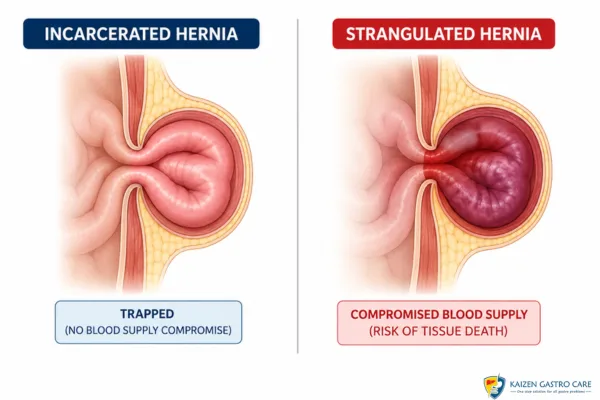
- An incarcerated hernia means the bulge is stuck and cannot be pushed back inside. But the blood supply is still working fine. It is uncomfortable, but it is usually not an immediate emergency.
- A strangulated hernia is one step further. Here, the blood supply has stopped completely. In the incarcerated versus strangulated hernia comparison, strangulation is always the more dangerous condition. It needs surgery right away.
At Kaizen Gastro Care, doctors always check this difference carefully before deciding the next step. A wrong guess here can cost precious time.
Which Hernias Are Most Likely to Get Strangulated?
Any hernia can strangulate. But some types are more commonly seen in hospitals.
- Strangulated inguinal hernia – This is the most common type. It happens in the groin area and is more common in men.
- Strangulated umbilical hernia – This happens near the belly button. It is more common in babies and in adults who are overweight.
- Strangulated femoral hernia – This is rare but more dangerous. It is more common in women and has a higher risk of strangulation compared to other types.
If you already have any of these hernias, do not ignore sudden changes in pain or size. Visit Kaizen Gastro Care or your nearest hospital quickly if something feels different.
What Causes Hernia Strangulation?
Hernia strangulation usually happens slowly, then suddenly gets worse. A small hernia opening can trap a loop of bowel. Over time, swelling increases. The blood vessels in that area get squeezed. This leads to strangulation of intestine, where the trapped part of the bowel does not get enough blood. Doctors also call this a strangulated bowel. Some common triggers include:
- Heavy lifting or sudden straining
- Long-standing hernia that was never treated
- Chronic cough or constipation
- Sudden increase in abdominal pressure
The strangulated intestine condition can also lead to infection spreading into the blood. This is why early treatment matters so much.
Emergency Warning Signs You Should Never Ignore
This is the most important section. Knowing the strangulated hernia symptoms early can literally save a life. So, what are the first signs of a strangulated hernia? Usually, it starts with sudden, sharp pain at the hernia site. This pain is different from your usual hernia discomfort. It is much more intense. Common signs of strangulated hernia include:
- Severe pain that comes on suddenly
- A bulge that turns red, purple, or dark
- Nausea and vomiting
- Fever and fast heartbeat
- Inability to pass gas or stool
- Swelling that increases quickly
What does a strangulated hernia feel like? Patients often describe it as a deep, constant, burning pain. It does not feel like normal muscle strain. It does not go away with rest. A question many patients ask is, does strangulated hernia pain come and go? In most cases, no. The pain stays constant and keeps getting worse. If your pain is coming and going, it may still be a hernia issue, but strangulation usually causes pain that does not settle down on its own. So how to know if hernia is strangulated? Check for these three things together: sudden severe pain, change in bulge colour, and vomiting or inability to pass stool. If you notice even two of these, do not wait. Visit a hospital immediately. The team at Kaizen Gastro Care advises all hernia patients to learn these symptoms of strangulated hernia in advance, especially if surgery has been delayed for any reason.
Is a Strangulated Hernia Life-Threatening? How Fast Does It Get Serious?
Yes, a strangulated hernia is life threatening if it is not treated quickly.
This is one of the most searched questions, and the honest answer is that time is the biggest factor here.
Once blood supply stops, tissue death can begin within four to eight hours. After this, the risk of gangrene, infection, and sepsis increases sharply. Sepsis means the infection spreads into your bloodstream. This can affect your whole body and become fatal if not controlled fast.
This short window is why doctors do not recommend waiting at home with these symptoms. Even if the pain feels manageable at first, it can become dangerous within hours.
How Doctors Diagnose a Strangulated Hernia
When you reach the hospital, doctors will first examine the hernia site. They will check the colour of the skin, the firmness of the bulge, and your pain level. Most of the time, a physical exam gives a strong clue. But doctors usually confirm it with a CT scan or ultrasound. This helps them see if the intestine is blocked and how much of it is affected.
At Kaizen Gastro Care, this process is kept quick and focused, because diagnosis speed directly affects the treatment outcome. Blood tests may also be done to check for infection or rising white blood cell count.
Treatment: What Happens During Emergency Surgery
Treatment for a strangulated hernia is always surgery. There is no medicine or home remedy that can fix this. Surgery aims to do two things: free the trapped tissue and restore blood flow. Depending on the case, the surgeon may choose:
- Open surgery – A single cut is made to push the hernia back and repair the muscle wall, often using a mesh for support.
- Laparoscopic surgery – A few small cuts are made using a camera and instruments. Recovery is usually faster with this method.
If the trapped part of the intestine has already died, the surgeon may need to remove that damaged section. This is called bowel resection. It is more complex but necessary to stop infection from spreading further. Surgeons at Kaizen Gastro Care explain every option clearly to patients and their families before the surgery, so there is no confusion during a stressful time.
Recovery, Risks, and Quick Checklist
Recovery time depends on the type of surgery and how much damage was already done. Simple cases may allow patients to return to light activity within a few days. Cases needing bowel resection take longer, sometimes one to two weeks in hospital. Common risks after surgery include infection, swelling, and in rare cases, hernia coming back. Following your surgeon’s advice on lifting and rest is very important during recovery.
Quick checklist – call for emergency help if you notice:
- Sudden, severe pain at a hernia site
- Bulge turning red, purple, or dark
- Vomiting along with hernia pain
- No gas or stool passing for hours
- Fever with hernia swelling
If even one of these matches your condition, do not delay. Reach Kaizen Gastro Care or your nearest emergency room right away.
FAQs about Strangulated Hernias
Yes. It always needs urgent medical attention and usually surgery within hours.
No. Surgery is the only treatment. Waiting can lead to serious complications.
Doctors generally consider four to eight hours as the critical window before tissue damage starts.
Hernias are common, but strangulation is rare when treated on time. The key is simple: do not ignore sudden pain, colour change, or vomiting near a hernia. Acting early gives the best chance for a smooth recovery. For consultation, diagnosis, or emergency hernia care, Kaizen Gastro Care is here to help you make the right decision, quickly and safely.