
- 23/06/2026
- Dr Vikrant Kale
- 0 Comments
- Digestive Disorder
When to Consult a Piles Specialist Based on Piles Grade?
Piles, also known as haemorrhoids, are one of the most common problems in India today. Yet most people avoid talking about it or delay seeing a doctor. This delay can turn a simple problem into a painful one.
So, what exactly are piles? Piles are swollen veins inside or around the rectum and anus. They form when too much pressure is put on the blood vessels in that area — due to constipation, straining during stool passing, or a low-fibre diet.
Now here is the important thing — not all piles are the same. The degree of piles or the grading of haemorrhoids tells you how serious your condition is. And this grading is what helps a specialist decide the right treatment for you. At Kaizen Gastro Care, Pune’s trusted gastroenterology and colorectal care centre, experts like Dr. Samrat Jankar (Senior GI & Laparoscopic Surgeon) diagnose and treat all piles grades with the latest, minimally invasive techniques. Knowing your piles grade can help you take the right step at the right time.
Understanding the Different Grades of Piles:
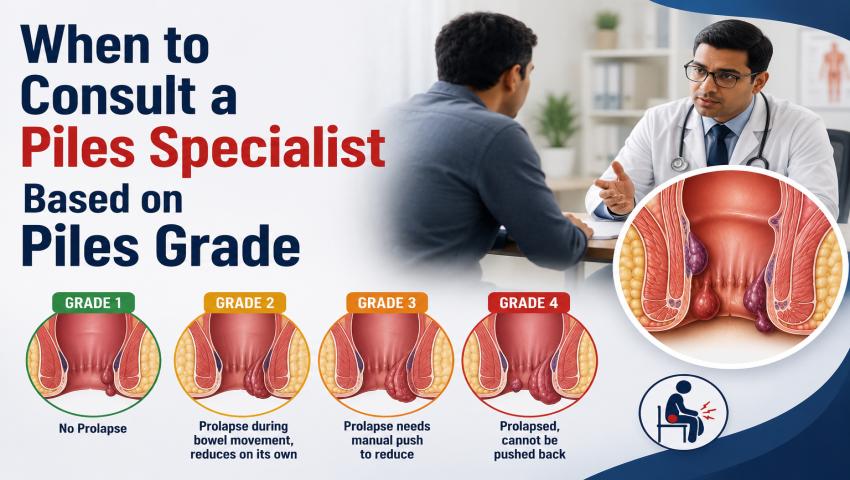
Doctors use a grading system to classify piles. This is called the grading of haemorrhoids. It helps understand how advanced the condition is. There are 4 piles grades in total — from mild to severe.
Grade 1 Piles (Piles First Stage / Stage 1 Piles):
This is the piles beginning stage. In Grade 1 or piles stage 1, the swollen veins are only inside the rectum. They do not come out of the anus at all.
At this stage, you may not even feel a lump. The most common signs are:
- Bleeding during or after passing stool (you may notice blood on toilet paper or in the toilet bowl)
- A mild burning or itching sensation near the anus
- Slight discomfort while passing piles stool
Many people ignore stage 1 piles because the symptoms seem minor. But this is actually the best time to see a doctor. Early treatment is simple, quick, and usually does not need surgery.
Grade 2 Piles (Stage 2 Piles / Piles Stage 2):
In piles stage 2, the haemorrhoid comes out of the anus during straining — such as when passing stool. But it goes back inside on its own once the straining stops.
Symptoms of stage 2 piles include:
- Visible lump that appears during bowel movement but disappears on its own
- More noticeable bleeding
- Itching and discomfort around the anal area
- Mucus discharge
This stage can be managed with non-surgical treatments in most cases. But if ignored, it progresses quickly to Grade 3.
Grade 3 Piles (Stage 3 Piles):
In stage 3 piles, the haemorrhoid comes out during a bowel movement — but this time, it does not go back inside on its own. You have to push it back manually with your finger.
Symptoms are more uncomfortable at this stage:
- A lump that stays outside unless pushed back
- Constant pain and heaviness in the anal area
- Regular bleeding
- Difficulty sitting for long periods
Stage 3 piles usually need medical intervention. Laser treatment or other minimally invasive procedures are commonly recommended at this stage.
Grade 4 Piles (Piles 4th Stage / Stage 4 Piles / Piles 4 Stage):
This is the most advanced stage. In piles stage 4 or the piles 4th stage, the haemorrhoid permanently stays outside the anus and cannot be pushed back in at all.
At this stage, symptoms are severe:
- A large, permanent lump outside the anus
- Constant pain and soreness
- Heavy bleeding
- Risk of infection or strangulation of the tissue
- Difficulty in daily activities like walking or sitting
Stage 4 piles almost always need surgical treatment. The longer you wait, the more complicated the surgery becomes.
When Should You See a Piles Specialist?
Many people ask — “Is my problem serious enough to see a doctor?” The answer is: yes, always. There is no piles grade that is too small to get checked. Here is what you should watch for at each stage.
1. Signs Grade 1 & Grade 2 Piles Need Medical Attention:
Even though piles stage 1 and piles stage 2 are considered early stages, you should see a specialist if:
- You notice bright red blood in your piles stool even once
- You have itching or discomfort that does not go away in a few days
- You feel like your bowel movement is incomplete
- You have been dealing with constipation for weeks
At these early piles grades, a doctor can easily treat the condition with dietary changes, medicines, or simple procedures like rubber band ligation or sclerotherapy. There is no need for surgery at this point.
Do not try to self-diagnose. Rectal bleeding can sometimes indicate other conditions too. A proper piles test — which may include a proctoscopy or colonoscopy — helps the doctor confirm the diagnosis and rule out anything else.
2. When Grade 3 Piles Require Specialist Treatment:
If you are at stage 3 piles, home remedies alone will not work. You need to consult a specialist. See a doctor immediately if:
- You are manually pushing back a lump after every bowel movement
- The bleeding is heavy or happens frequently
- You have constant pain that affects your daily life
- You notice mucus or discharge regularly
At this stage, laser treatment for piles is one of the best options available. It is quick, nearly painless, and has a very fast recovery time. Specialists at Kaizen Gastro Care in Pune use advanced laser techniques to treat stage 3 piles effectively, with minimal discomfort.
3. Why Grade 4 Piles Need Immediate Consultation:
Stage 4 piles or the piles 4 stage is a medical emergency of sorts. You should not delay at this point.
See a specialist immediately if:
- A lump outside your anus will not go back inside
- You are in severe or constant pain
- You have very heavy or persistent bleeding
- There are signs of infection — fever, swelling, or foul smell
Piles 4th stage treatment almost always involves surgery. But modern techniques like laser haemorrhoidectomy make the procedure much easier and recovery faster than traditional methods. Delaying treatment at this stage can lead to serious complications like thrombosis, gangrene, or severe anaemia due to blood loss.
How Many Kinds of Piles Are There?
When it comes to piles types, there are two main kinds — internal piles and external piles. Internal piles form inside the rectum, while external piles form under the skin around the anus. Both types of piles in male and types of piles in female follow the same grading system and can occur at any age.
Piles is also sometimes called by its other names — haemorrhoids or bawaseer in Hindi. Regardless of the name, the symptoms and grading remain the same.
Book an Appointment with a Piles Specialist in Pune:
If you are experiencing any of the above symptoms — even mild ones — do not wait. Early-stage piles are much easier and less painful to treat.
Kaizen Gastro Care, located in Wakad, Pune, is one of the most trusted centres for piles treatment in Pune. Led by Dr. Samrat Jankar (17+ years of experience, 5,000+ successful anal fistula surgeries) and Dr. Vikrant Kale (18+ years of experience), the team offers:
- Expert diagnosis of all piles grades through proctoscopy and other tests
- Non-surgical treatments for Grade 1 and Grade 2 piles
- Laser treatment for Grade 3 piles
- Advanced surgical options for Grade 4 piles
You can book an appointment online or call 09763635252. Online consultations are also available.
Conclusion:
Piles is not a condition you should be embarrassed about or ignore. It affects millions of people in India — men and women alike. The key is to understand your piles grade and act accordingly.
- Stage 1 piles and stage 2 piles — See a doctor early for simple, non-surgical treatment
- Stage 3 piles — Get medical help soon; laser treatment works very well
- Stage 4 piles — Do not delay; immediate specialist consultation is essential
The degree of piles you are at right now decides how easy or difficult the treatment will be. The earlier you visit a specialist, the simpler, faster, and less painful your recovery will be. If you are in Pune and looking for the best pile doctor, Kaizen Gastro Care is here to help you at every stage of your healing journey.